


This article is for you if…
- Your teams still switch between five tabs to answer one customer question.
- Your sales reps spend more time logging calls than closing deals.
- Your customers have to repeat their story, even though you have a CRM.
If even one of these sounds familiar, you’re not facing a tool problem. You’re facing a customer lifecycle design problem.
The Customer Lifecycle Is No Longer Linear
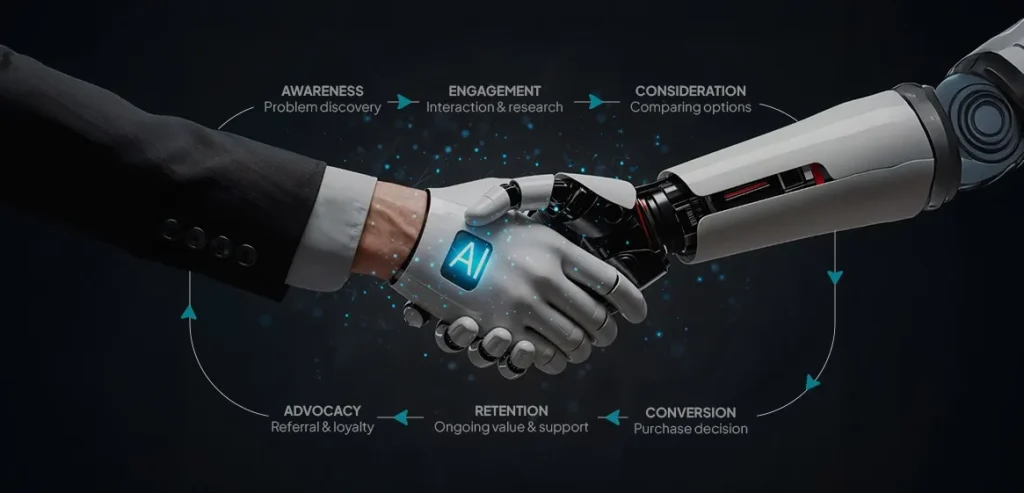
The traditional funnel is dead. In its place is a complex, multi-dimensional web where the customer dictates the pace and the path. Today’s buyer might discover you on social media, ask a question via WhatsApp, research your pricing online, and close the deal over a phone call.
The Expectation Gap
Customers don’t care about your internal departments, they care about their own time. They expect instant responses, personalization, and seamless transitions. Most businesses face a fragmented reality instead:
- Disconnected tools: Data trapped in silos.
- Overloaded talent: Agents spending 30% of their day on administrative work, logging calls, syncing notes.
- Underutilized AI: Costly models that can’t perform because they lack access to real-time communication data.
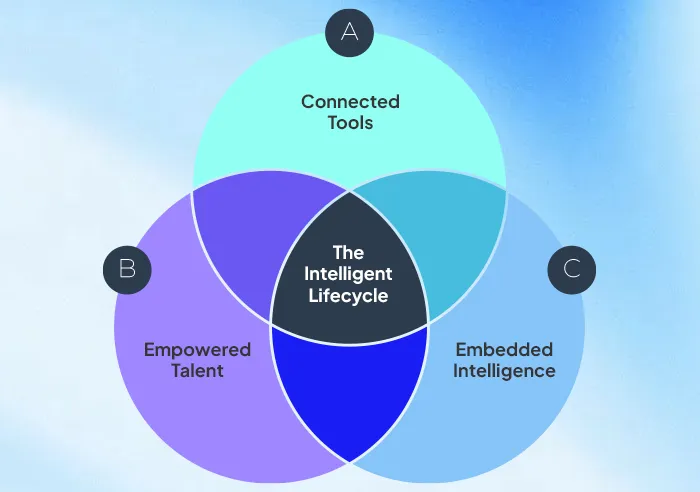
The solution isn’t more technology. It’s the right balance of tools, human judgment, and embedded intelligence. Lean too hard on any one pillar, and the cutomer experience doesn’t just bend, it breaks.

Most enterprises are stuck in “customization chaos.” Communication is scattered across personal SMS, unrecorded mobile calls, and disconnected WhatsApp accounts. When an agent switches between five tabs to answer one question, the customer feels the friction.
The Mandate Shift:
- Move from Isolated Channels to Unified Engagement: Stop viewing SMS and Voice as “add-ons.” They are the primary sensory inputs of your CRM.
- Move from Manual Effort to AI-Assisted Intelligence: We must move away from agents “feeding the machine” and toward a machine that feeds the agent with the right information at the right time.
- Move from Reactive to Context-Driven: The goal is Zero-Latency. By the time a customer says “Hello,” your system should already have processed their recent SMS sentiment and web activity.
The Three Forces Powering the Intelligent Lifecycle
Orchestration is not a single software feature; it is a delicate equilibrium, combining three powerful forces of customer lifecycle.
Force #1: Connected Communication (The Right Tool)
To deliver a continuous lifecycle, every interaction must automatically contribute to the customer’s “Living Profile.” Technology must serve as the high-speed infrastructure of the enterprise. In a modern lifecycle, tools are the “sensory inputs” that capture every pulse of customer intent without requiring manual intervention.
By embedding tools like 360 CTI directly into the CRM, voice becomes a visible, trackable asset rather than an isolated event. With features like click-to-call, automated call logging, and real-time screen pops, it ensures that when a phone rings, the agent isn’t guessing, they are prepared.
Similarly, the speed of the lifecycle depends on meeting customers where they live. Tools like 360 SMS bring 1-on-1 texting and WhatsApp right into their Salesforce ecosystem. It allows for trackable, compliant, and automated messaging that ensures your brand stays in the customer’s pocket without ever leaving the CRM.
Force #2: Empowered Talent (The Right Human)
“AI won’t replace humans. But humans who use AI will replace those who don’t.”
– Sam Altman, Co-founder and CEO, OpenAI
This modern shift isn’t about substitution; it’s about evolution; the machine provides the scale, but the human provides the soul.
We are entering an era where “empathy is the economy.” As AI handles the routine, the role of the human agent becomes more critical, and more difficult. Humans are closers, empathetic listeners, and strategic problem-solvers.
- Architects of trust: Human agents excel in complex negotiations, high-stakes problem-solving, and service recovery where context and consequence are high.
- Empathy as an asset: Humans interpret the emotional “vibe” of a situation in ways that go beyond binary logic.
- Strategic focus: Freed from manual data entry, talent can concentrate entirely on relationship-building and revenue.
- The AI-Savvy Workforce: The modern professional is a “Pilot of Intelligence.” This new breed of skilled resource is tech-literate, knowing exactly when to let an autonomous agent handle a task and when to intervene to pivot a conversation.
Force #3: Embedded Intelligence (The Right AI)
A new Salesforce study of CIOs finds AI adoption has skyrocketed 282%, a sign of the technology’s pull. AI is not a “plug-in”; it is the connective tissue. For AI to be effective, it needs a constant stream of high-quality data. In the past, AI was “blind” to what happened on phone calls or in text threads.
- Autonomous Processing: AI handles the “Predictable Path.” It manages high-volume, low-complexity tasks like order tracking, lead triaging, and basic FAQs, operating 24/7 without fatigue.
- Predictive Insights: By analyzing thousands of data points, AI identifies which leads are “hot” based on sentiment and which customers are at risk of churning based on engagement lulls.
- Precision Routing: The intelligence engine ensures that every inquiry is directed to the most qualified resource instantly, minimizing wait times and maximizing the probability of a successful outcome.
- The Core Objective: To provide “Synchronized Intelligence” that identifies the “Next Best Action” at every stage of the lifecycle, ensuring the business moves with total precision.
What This Intelligent Orchestration Actually Delivers
Orchestration isn’t just an operational “nice-to-have”; it is an enterprise value engine.
- Faster Response Times: Kill the “Wait Time” penalty. A Salesforce-native solution can generate instant automated acknowledgments and AI-driven triage, resolving majority of queries before a human even touches a keyboard.
- Higher Conversion Velocity: Seconds matter in sales. When a native CTI solution pops a lead’s full call history onto a rep’s screen the moment the phone rings, they stop “qualifying” and start “closing.”
- Hyper-Personalization: Move beyond “Dear [First Name].” True personalization means your AI agent analyses the conversation, scores lead, detects sentiment, auto-suggest replies.
- Elevated Customer Satisfaction: The #1 driver of loyalty is Continuity. When a customer never has to repeat their story because your tools share a single memory, CSAT scores don’t just rise, they stabilize.
- Higher Lifetime Value (LTV): Proactive engagement via SMS, triggered by AI and handled by a human, turns a one-time buyer into a lifelong advocate. You aren’t just solving a problem; you’re designing a relationship.
Competitive Advantage: The ROI of Continuity
In 2026, the ultimate differentiator isn’t your product, it’s your memory. While most companies treat every interaction as a new start, an orchestrated enterprise maintains a single, unbroken record of the customer across years, channels, and departments.
- 3x faster sales: Instant data logging eliminates “repeat your story,” moving prospects from hello to closed faster.
- The “known” factor: Unified CRM profiles create a zero-reset experience that builds trust and loyalty.
- Growth without hiring: Automating data entry doubles capacity without increasing headcount.
The Future is Hybrid, Not Fully Automated.
The most common mistake in modern digital transformation is the belief that “more AI” equals “better service.” In reality, an automated system without a human heart is cold, and a human team without high-speed tools is overwhelmed. The future of the customer experience isn’t a choice between people and bots; it is the perfect hybrid.
Adding more apps doesn’t solve fragmentation; it deepens it. The goal is to strip away the noise so your talent can focus on the signal.
The objective isn’t just “more technology.” It is the synchronization of your Logic, your Empathy, and your Connectivity. When these three move in lockstep, your business gains a “collective memory” that competitors simply cannot match.