
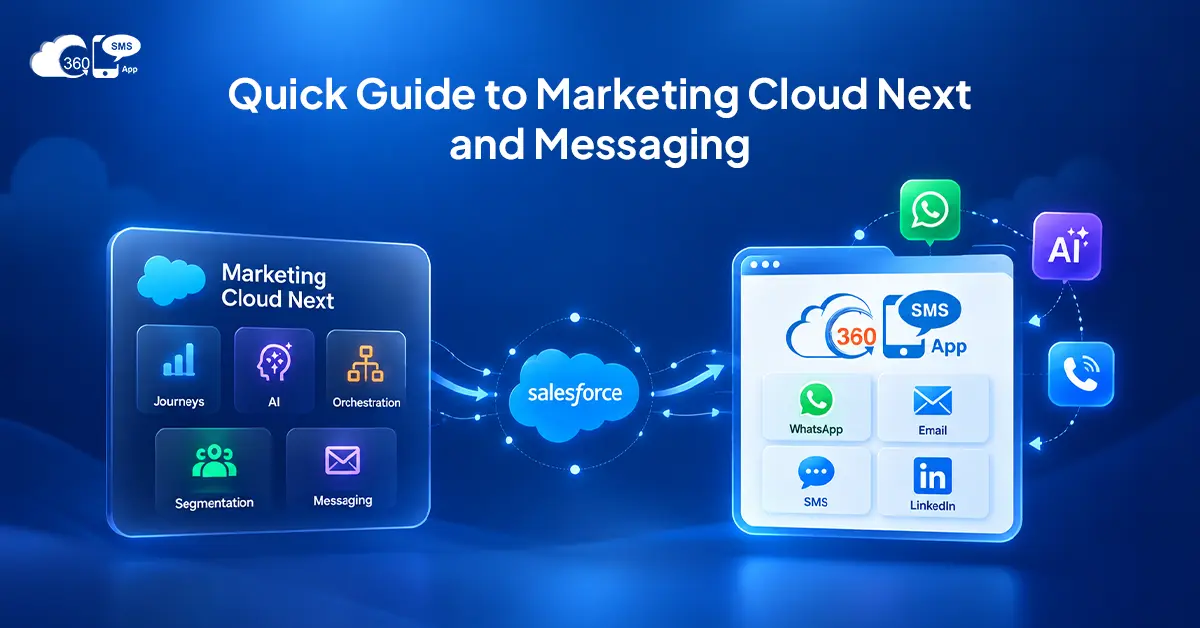

That’s a real structural shift. Not a rebrand. The channels, the data connections, the triggers — they all live differently now.
For teams not on Marketing Cloud Next, a native SMS app for Salesforce still covers two-way SMS, WhatsApp, and 11 additional channels without the platform investment or Data Cloud requirement.
What Messaging Looked Like Before MCN
In Marketing Cloud Engagement, SMS was handled through Mobile Studio and MobileConnect as a separate module — not natively connected to Sales Cloud or Service Cloud data, requiring a separate login and platform.
In practice, this meant two logins, two data environments, and a connector (MC Connect) that bridged them but introduced sync lag and duplicate records on a regular basis. WhatsApp wasn’t native at all — it required third-party WhatsApp Business API configuration built outside Salesforce, then patched back in. RCS didn’t exist in the product.
Most teams either built connector workarounds or quietly skipped the channels that were too painful to wire up.
Marketing Cloud Next Messaging: The Complete Release Timeline
Marketing Cloud Next’s messaging capabilities have shipped across four major releases: the initial launch (June 2025), Winter ‘26 (October 2025), Spring ‘26 (February 2026), and Summer ‘26 (June 2026).
See Marketing Cloud Next pricing for current edition and add-on costs.
| Release | Date | What Shipped |
| MCN Launch | June 2025 | SMS and WhatsApp as add-ons; one-way sends; Flow-triggered SMS |
| Winter ‘26 | October 2025 | Two-way SMS announced; push via Unified SDK; WhatsApp interactive messages |
| Spring ‘26 | February 2026 | Two-way SMS full availability; conversational email via Agentforce; dedicated IP |
| Summer ‘26 | June 2026 | RCS native launch; AMPscript support; multilingual messaging; custom fonts |
| Winter ‘27 | October 2026 | Self-optimizing campaigns; RCS expansion; flash messaging; WhatsApp username targeting |

SMS in Marketing Cloud Next: What Actually Changed
Marketing Cloud Next supports SMS as a paid add-on starting at $2 per 1,000 credits (US pricing — see Marketing Cloud Next pricing for regional rates). Unlike MobileConnect, MCN SMS triggers natively from Salesforce Flows and CRM events — not from a separate Journey Builder interface.
That’s the thing. The old model required teams to build journeys in a standalone marketing platform just to send a basic text. Now any Salesforce Flow can fire an SMS on any object: an Opportunity stage change, a Case update, a custom field flip. No separate platform required.
Two-way SMS reached full availability in Spring ‘26 (February 2026). Customer replies route back to the CRM record. In Advanced edition, Agentforce agents handle those replies automatically.
Worth saying: two-way SMS (Unified Conversations) is not available in the Growth edition. You need Advanced, at $3,250 per org per month. All SMS setup in MCN also requires Data Cloud (Data 360). Not optional — it’s baked into how MCN provisions messaging.
WhatsApp in Marketing Cloud Next: What Actually Changed
How much friction did the old WhatsApp setup create? Enough that most mid-market teams skipped it entirely. MCN changes that.
Marketing Cloud Next includes WhatsApp natively through the WhatsApp Business API, with support for interactive message types — buttons, lists, location sharing — all triggerable from Salesforce Flows. It sits in the same interface as SMS and email now, not off to the side in a separate configuration.
Winter ‘26 added CTA buttons, location sharing, and WhatsApp Flows. Winter ‘27 adds username targeting, which lets you reach customers when a phone number isn’t available. Pricing follows the same credit model as SMS — see Marketing Cloud Next pricing for current rates.
For teams evaluating WhatsApp specifically for CRM use without the full MCN commitment, a WhatsApp integration for Salesforce is worth looking at separately.
RCS in Marketing Cloud Next: The Channel That Just Landed
Salesforce launched native RCS (Rich Communication Services) support in Marketing Cloud Next as part of Summer ‘26 (June 2026).
RCS is the technical successor to SMS — branded, media-rich messages delivered inside the device’s native messaging app. Verified sender identity with a logo and checkmark. Inline images and video. Interactive buttons. Read receipts. No separate app download required on the recipient’s end.
In MCN, RCS uses the same Flow-triggered architecture as SMS, with automatic fallback to SMS or MMS for non-RCS devices, carriers, or when no data connection is available. RCS credits are billed separately from SMS — check Marketing Cloud Next pricing for current rates before scaling campaigns. Current availability requires the Marketing Cloud Engagement Plus tier, and carrier and regional coverage is still rolling out.
To be fair, 360 SMS had RCS available before MCN’s Summer ‘26 launch — teams that needed it early didn’t have to wait.
Conversational Email: The Capability Nobody Predicted
Spring ‘26 (February 2026) brought something that wasn’t on most roadmap predictions. MCN introduced conversational email: outbound marketing emails can now route customer replies through Agentforce AI agents that read, respond, and take action — instead of bouncing to a do-not-reply address.
In practice, this means every campaign email can have a monitored reply address. A customer replies with a question; an Agentforce agent reads it, responds with CRM data, and escalates to a sales rep when the conversation gets serious. That’s a real change in how email and CRM connect.
Available in Advanced edition. Agentforce action credits are billed separately per conversation.
Push Notifications and Mobile App Messaging
Marketing Cloud Next added push notification support via the Unified Marketing Cloud SDK in Winter ‘26 (October 2025), letting teams send push notifications alongside SMS, WhatsApp, and email from a single platform.
Previously, push required Marketing Cloud Engagement’s Mobile Studio as a separate implementation with its own SDK. Winter ‘27 adds flash messaging — urgent, high-priority in-app messages for mobile audiences.
MCN Messaging vs Marketing Cloud Engagement: Channel by Channel
Marketing Cloud Next consolidates all messaging channels — SMS, WhatsApp, RCS, email, and push — into a single native platform, replacing the separate Mobile Studio, MobileConnect, and Journey Builder setup required in Marketing Cloud Engagement.
| Channel | Marketing Cloud Engagement | Marketing Cloud Next |
| SMS | MobileConnect (separate module) | Native, Flow-triggered, $2/1K sends |
| Two-way SMS | Journey Builder setup required | Unified Conversations (Advanced only, Spring ‘26) |
| Third-party API configuration | Native first-class channel | |
| RCS | Not available | Native, Summer ‘26 |
| Conversational email | Not available | Agentforce-routed replies, Spring ‘26 |
| Push notifications | Mobile Studio (separate SDK) | Unified SDK, Winter ‘26 |
| CRM data in messages | Via MC Connect (sync lag) | Native real-time, no sync |
| Trigger from Salesforce Flows | Not natively | Any Flow, any object |
What These Changes Actually Mean for Salesforce Teams
MCN’s messaging changes are most valuable for teams running large-scale campaign orchestration across email, SMS, and WhatsApp from a single Salesforce-native platform — but require Advanced edition for two-way conversations and Data Cloud for all messaging setup.
That’s the thing. Campaign-heavy marketing teams already invested in Salesforce infrastructure get exactly what they’ve been waiting for: unified channels, AI-personalized sends, Agentforce managing two-way replies at scale.
But Sales Cloud and Service Cloud teams who want SMS or WhatsApp for day-to-day rep texting? MCN isn’t designed for that use case. Recruiter-to-candidate, collections-to-customer, field service rep-to-client — these are operational conversations, not marketing campaigns. Buying a $39K/year Advanced license for basic CRM texting is overhead most sales teams can’t justify.
For those teams, a native AppExchange SMS app handles two-way SMS, WhatsApp, and 15 channels on any Salesforce edition without Data Cloud. Send SMS from Salesforce without Marketing Cloud covers what that setup looks like.
In practice, the question often isn’t “MCN or a third-party app.” For many organizations it’s both: MCN for marketing campaign orchestration, 360 SMS for 1:1 operational messaging across 15+ channels and different functions.
Final Thoughts
MCN’s messaging rebuild is real and worth understanding properly. Every major channel now lives natively on the Salesforce platform, journey triggers connect directly to CRM events, and the two-way conversation layer — while Advanced-only — works well for the teams it’s built for.
For teams that need CRM-level texting without the enterprise MCN commitment, a native SMS app for Salesforce covers two-way SMS, WhatsApp, and 11 more channels in about 20 minutes, on a flat subscription, with no Data Cloud requirement.
The practical detail: a Sales Cloud team sending rep-to-prospect texts has no use for a $39,000/year marketing platform.
Need Salesforce messaging across functions without data cloud dependency?