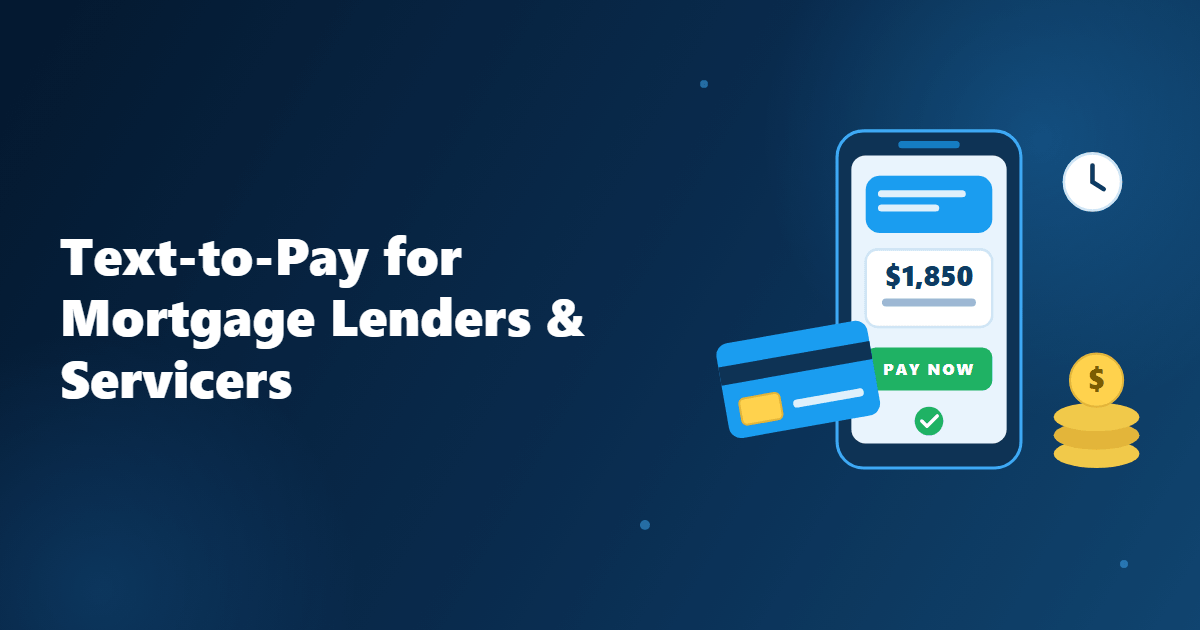
 Text-to-pay lets mortgage lenders and servicers send borrowers a secure SMS payment link they can pay from in under a minute — no portal login, no phone tree, no mailed coupon. Because 98% of texts get read and most within three minutes, servicers using payment reminder texts see fewer late payments, lower call-center volume, and faster collection of fees at every loan stage — all logged automatically through a Salesforce SMS integration.
A missed mortgage payment usually isn’t a money problem — it’s a friction problem. The borrower meant to pay, but the portal password reset failed, the mailed statement sat unopened, and the due date slipped. Text-to-pay for mortgage lenders removes the friction: a reminder text arrives, the borrower taps a secure link, and pays on the spot.
Table of Contents
What Is Text-to-Pay for Mortgage?
Text-to-pay is a payment flow where the servicer or lender sends an SMS containing a secure, tokenized payment link. The borrower taps it, confirms the amount on a mobile-optimized page (card, ACH, or wallet), and receives an instant confirmation text. No app, no login, no hold music.
For mortgage teams on Salesforce, the entire loop — trigger, message, link click, payment confirmation — writes back to the loan record automatically.
Where it fits in the loan lifecycle
| Stage | Payment | Why SMS wins |
|---|---|---|
| Application | Appraisal fee, credit report fee, application fee | Collect in minutes instead of stalling the file |
| Processing | Rate lock extension fees | Time-critical; email is too slow |
| Servicing | Monthly principal & interest | Reminder + link beats statement + portal |
| Delinquency | Past-due payments, repayment plans | Non-confrontational channel; higher engagement than calls |
| Escrow | Shortage payments | Clear explanation + one-tap payment |
 Why Payment Reminder Texts Outperform Every Other Channel
 Why Payment Reminder Texts Outperform Every Other Channel
- Read rates: ~98% for SMS vs ~20% for email vs single digits for outbound calls answered.
- Speed: 90% of texts are read within 3 minutes — a reminder sent on the 1st actually gets seen on the 1st.
- Preference: most consumers now prefer text over calls for billing matters, and industry studies consistently show reminder texts reducing late payments by 25–40% in recurring-payment contexts.
- Cost: an automated text costs pennies; a collection call costs $5–$15 of agent time. For a servicer with 50,000 loans and a 4% delinquency rate, shifting even half of collection contacts from phone to SMS saves six figures annually.
How to Set Up Text-to-Pay for Mortgage Servicers in Salesforce
1. Connect payments to messaging
Use a Salesforce-native texting platform like 360 SMS App that generates secure payment links (via your payment gateway) inside message templates.
2. Build the reminder cadence
A proven servicing sequence:
- Day –5: “Hi {FirstName}, your mortgage payment of {Amount} is due {DueDate}. Pay in one tap: {link}”
- Day 0 (due date): “Friendly reminder — today’s the day. {link}”
- Day +3 (grace period): “Your payment hasn’t come through yet. Avoid a late fee — pay by {GraceEnd}: {link}”
- Day +10: “We’re here to help. Pay now {link} or reply HELP to talk about options.”
Every message stops automatically the moment payment posts — the same conditional logic behind borrower document follow-up automation.
3. Route replies to humans when it matters
A borrower who replies “I lost my job” should never get another automated nudge. Keyword detection flags hardship language, pauses the sequence, and creates a case for your loss-mitigation team — with the full conversation already on the Salesforce record. (An AI borrower assistant can handle the routine questions and escalate the sensitive ones.)
4. Confirm and receipt every payment
Instant confirmation text + email receipt, both logged. Confirmations aren’t just courtesy — they cut “did my payment go through?” calls dramatically.
Compliance: Payment Texts Done Right
Payment reminders are transactional, but the rules still apply:
- Consent: capture express consent for servicing texts at closing or onboarding (any account-relationship consent should explicitly include payment notifications).
- FDCPA overlay for delinquent accounts: if messages relate to debt collection, follow Reg F — reasonable contact frequency, opt-out honored immediately, no third-party disclosure. Text is actually safer than voicemail here because it’s inherently private to the device.
- Security: never put full account numbers or balances in the message body; the tokenized link carries the details behind authentication.
- Registration: high-volume payment programs are the classic use case for a short code; smaller lenders run fine on registered 10DLC. Full details in our mortgage texting compliance guide.
Beyond Collections: Text-to-Pay as Borrower Experience
The same rails that collect payments build loyalty:
- Escrow clarity: “Your escrow analysis is ready — your new payment is {Amount} starting {Date}. Questions? Reply here.” Fewer surprises, fewer angry calls.
- Payoff and milestone moments: confirmations and congratulations texts turn a servicing interaction into a relationship touch — the philosophy behind keeping borrowers coming back with automated SMS.
- Cross-lifecycle continuity: the borrower who pays by text today is the refi lead who answers your drip campaign tomorrow — because the number, the consent, and the history all live on one Salesforce record, part of a complete Salesforce texting integration.
Collect Faster. Call Less. Keep Borrowers Happier.
360 SMS App brings text-to-pay, payment reminder sequences, and two-way borrower conversations into Salesforce — one record, full compliance, zero portal friction.